
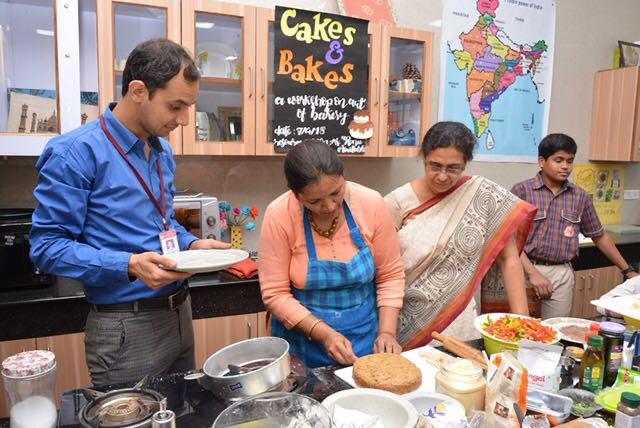

About 10 years ago, when I started my baking journey, there was a Eureka moment when I successfully baked my first bread but then there was a big regret that why didn’t I start baking much earlier? The answer was that I was afraid to begin. SoonI realized that my fears were completely unfounded. Today, after baking regularly, almost every day, for the last 10 years and also teaching my baking community for a long time, I am here to debunk some myths about bread baking at home.
Myth: Yeast needs a warm environment and sugar to become active, else the breads don’t bake properly.
Fact: Yeast is active in a cold environment as well! It just takes more time. We can ferment or prove the dough even in a refrigerator. The only difference is the process will be slower. This is called retarding. This slow rise gives great flavor and texture to our breads. So, if it takes 1 hour for the dough to ferment or double in size at room temperature, which is say 35 degrees Celsius, it should be done in the refrigerator at 5 degrees temperature in about 6 to 7 hours. We can keep it in for a still longer time for sourdough breads, baguettes etc.
Yeast feeds on flour which has carbohydrates (sugar) and does not require extra sugar for becoming active. Some sugar is added to the dough either for flavor or to make some doughs richer as per the recipe. However, it is not a must for good breads. When I suggested the yeast proof test and asked that some sugar be added, it was to expedite the process. But remember, sugar is not essential to activate the yeast.
Myth : Baking is a difficult and complex process.
Fact: We are just baking breads, you just have to start learning like any other skill or art. It is very simple and doable. No one should be deterred by the list of exotic ingredients and gadgets or terms and jargon used by some bakers. Always remember that the basic bread needs only 3 ingredients –flour, water, yeast. Everything else in the ingredients list is for special effects and for a special recipe. Once you know how to make the basic bread dough half the job is done! Further, it is your ingenuity and creativity that makes you experiment with add-ins like herbs, veggies, cheese, sugar, spices, milk, nuts, fruits etc. But, again remember, this is all optional and excusable! Friends, we already have all the ingredients and tools required for baking in our kitchen. Just follow the rules-learn to knead the dough, understand the steps and take the plunge!
Myth : Baking is time consuming and tedious, something I would not like to engage in after a long day.
Fact: From start to finish, a bread loaf takes 2 hours to prepare. Buns and calzones and pizzas take half an hour less. The duration for which you need to be present for the activity is less than half an hour (five minutes for preparation, ten minutes for kneading, five minutes for shaping) and believe me all this is very therapeutic and relaxing and not tedious.
Cold proving/overnight proving is another great option. It is recommended for slow rise and sourdough breads. In such recipes we use less amount of yeast. These slow breads are delicious, full of flavor, have nice crumb and need much less kneading. So it is a win-win for those who have less time during the day and they can try slow baking.
Myth: Breads are not healthy, as they have fat, sugar, salt and are bad for the gut.
Fact: Homemade breads are without any additives, chemicals, emulsifiers and stabilizers. They all contain fresh ingredients and the fermentation process brings out the nutritious elements, apart from making the grains easily digestible. These are very good for our health. Salt and sugar are added in very limited quantities and fat is not an essential ingredient in the bread recipe. And home bakers will always have the option of customizing their bread, pizza, garlic bread, etc. as they like it. Remember, our basic bread has only three ingredients– flour, water, yeast and we have an option to add seeds, herbs for flavor and added nutrition.
Myth: Breads must be kneaded for a long time, for the gluten to develop.
Fact: The rule of thumb is to knead for about 10 minutes for good gluten development, especially when using wheat flour with less protein than 12 %, as we do. Bread flour, high protein wheat flour and AP flour which have more protein require less effort as gluten forms easily. Adding wheat gluten to the dough also reduces the kneading time and effort. However, if you make slow rise bread or sourdough breads, you may just knead for 2 minutes or so, then stretch and fold or coil fold and prove for a long time. This will help develop gluten. There are also no-knead breads, where only stretching and folding is needed. Eggs and other leavening agents such as flaxseeds and natural stabilizers such as vinegar, lemon juice, when added, aid in structure formation of the loaf, which in turn reduces the kneading time. The dough of banana breads or some pumpkin breads, where we use baking powder and baking soda, do not require kneading either. Don’t be wary of kneading because you can use a dough mixer too. But believe me, it is a soothing and therapeutic process and you really enjoy the rhythm, once you get the hang of it. Most bakers in our group are kneading by hands and are enjoying it thoroughly. Moreover, the satisfaction of baking artisan breads all by oneself means a lot to new bakers! And SOURDOUGH Breads are no knead breads!
Myth: More yeast (or expensive yeast) means a better bread!
Fact: Yeast is the most elusive ingredient. Its mysteries often disconcert new bakers and doubts of even the regular bakers have not yet been fully addressed. The fact is that you do not need too much yeast, else the breads taste yeasty. More yeast is required for mechanical and speedy baking, which you might find in commercial bakeries.
However, we home bakers go slow, and patience is our virtue. We use 6 to 7 grams of yeast in 450 grams of flour for a normal loaf and it can be reduced to 3 to 4 grams for a slow rise loaf. When we want to let the dough rise for a long time, we cut out most of the yeast, from the typical 2&1/4 th teaspoons that come in a yeast packet, to one teaspoon or so. That way the dough rises slowly as the yeast will take more time to ferment the dough. If the dough rises too quickly because of more yeast, the flavor will not develop. With practice you find that less yeast yields a more delicious and flavorful bread! Remember that any yeast is good and will give similar results. Only the sourdough starter is better and makes very healthy breads and that we make ourselves!
Myth: Quick rise bread, and yeast free breads, are also Real breads!
Fact: Many quick rise breads are made with baking soda and baking powder where the chemical reaction is different than that of yeast breads. These baking agents also help in expanding the dough and such breads do rise well, but they are very similar to cakes in texture. Curd/milk or fat is added to assist in forming the structure (instead of gluten) as in banana, pumpkin, zucchini or other soda breads. Eggs are also used, which help in baking and rising of these breads. Traditional breads are yeast breads. Yeast not only plays a key role in the leavening of the dough, but it also provides bread with a unique taste and texture. The yeast and the fermentation process, specially the slow fermentation or use of sourdough culture, further enhances the nutritional quality.
Myth: Gluten free breads are always healthier.
Fact: Gluten free breads are often the choice of people with gluten intolerance or sensitivity. People who have gluten intolerance, or gluten sensitivity, should consult their doctors before eating regular wheat or maida breads in which yeast is used as gluten could cause health complications. If there is stomach discomfort after eating yeast breads (made of wheat and other grains such as rye, barley), then you should consult your doctor. For such people breads can be made from rice, millets, amaranth and other gluten free grains.
For all others, these regular wheat breads, especially the ones we bake fresh at home with no additives, are very healthy and a great substitute for factory made breads. Rather, there are several micro nutrients in wheat and other gluten grains and such breads are nutritious and rich in fiber. The fermentation process during baking makes them digestible and these nutrients are easily absorbed. Sourdough breads are the healthiest and latest researches show that sourdough breads have properties which are anti inflammatory, anti hypertensive, anti cellular damage and good for diabetes.
Myth: Baking the same bread with the same process over and over again, will become boring.
Fact: Here I am, baking regularly for 10 years now, along with our big community of more than 1000 home bakers who are also baking regularly. Believe me, there is not a single boring day and never a dull moment, as neither any two breads nor any two baking experiences are the same! Artisan breads are all different and surprise you every time!
Closing thoughts
Remember: you are baking. You are creating a new experience each day. You are contributing to the health of your family and yourself. You know what is in your bread and you know how to make it even better. The same master dough can be folded into different shapes, with different fillings and baked with different techniques. You are only limited by your imagination!

Hope the myths stand busted and new bakers are ready to hop on our bandwagon!!
Happy Baking!