
Our family’s favorite namkeen is ‘All In One’. Our favorite food-court order ‘Thali’. I recall that since childhood, I was fixated on completing the entire syllabus, even when I could have skipped some topics. I continue to do this as a baker. You all know that we put a special focus on healthy baking in all our recipes. For the breads I bake at home, I tend to add all most nutritious ingredients in one bread.
Wheat, multi grains, seeds, eggs, whey water, buttermilk, nuts meal, olive oil, honey, lemon– sometimes semi-cooked porridge and even oats.
How to tackle coarse grains?
Grains like corn, amaranth, buckwheat, flax, millets etc. are very nutritious, but the breads baked from their flour are very dense or there is no gluten for elasticity and so there is no open crumb structure. Usually, your options are to add bread improvers or wheat gluten. We want to keep recipes simple and sans additives or non food of any sort. So, I have added some maida, a dash of soda, soaked flaxseed and chia seeds, lemon or vinegar say a tsp and use milk, buttermilk, some oil/ butter.
I know this seems like a handful, but we get tasty, soft, nutty breads. More importantly, this allows me to add a variety of multi-grain flours for that extra healthy spin.
Ingredients
The all in one ingredients photo.
• Wheat flour – 1 cup (140 grams). Beginners can use 1/2 cup!
• Maida – 1/2 cup (60 grams). Beginners can use 1 cup!
• Mixed millet flour – 1/2 cup (70 grams) (bajra, ragi, quinoa)
• Buckwheat flour – 1/4 cup (35 grams)
(clockwise from top-left) Millets, Buckwheat, Aata and Maida. All organic.
• Oats – 1/2 cup . They should be soaked in warm water for 1/2 an hour. Water should be enough to cover it.
• Mixed seeds – 1/4 cup (chia, flax, sunflower. sesame, pumpkin, soaked in warm water and then grind coarsely) Some more for topping before baking.
• Isabgol or psyllium husk – 1 tbsp (soaked in warm water)
From left to right: Oats, seeds, psyllium. Don’t forget to soak!
• Fresh herbs such as coriander, basil, mint or dry kasoori methi and/or spice, if you may.
• Apple cider vinegar or lemon or vinegar – 2 tsp
• Honey – 1 tbsp
• Salt – 1 tsp
• Baking Soda – 1 pinch
• Buttermilk or milk and water mixture for kneading – 1&1/4 cup to make a soft dough.
• Olive oil – 2 tbsp
• Yeast – 2 tsp
What if I don’t have buttermilk?
If there is no buttermilk at hand use curd water mix or milk and water mix. Curd and buttermilk or milk helps in making softer breads specially when using coarse grains and also help in leavening. The protein helps give a nice brownish hue to the crust.
Steps:- Procedure is same as Whole wheat Bread. Some important points for this particular bread:
Knead well with liquids at room temperature or just lukewarm, for at least 10 minutes. The dough should be very soft (much softer than our chapati dough).
•
•
(left) Mixing ingredients; (right) After kneading.
Ferment for slightly longer time than the normal wheat or wheat maida bread dough, say 1 hour in this warm weather such that it doubles.
Dough, after rising.
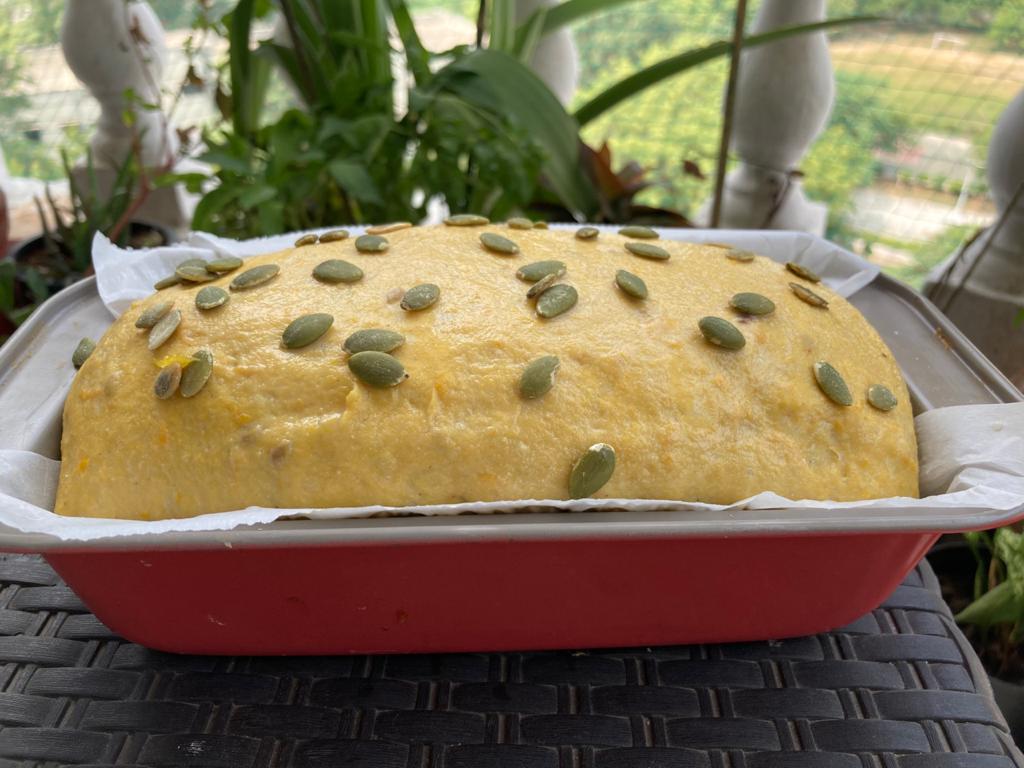
Deflate, prove in loaf tin for 1/2 an hour (warm weather) till it takes the shape of a nice loaf and rises slightly above the tin. Ensure it doesn’t go flat or cracks. The bread will rise further while baking.
In the oven. Almost done!
Bake at 180 degrees Celsius for about 40 minutes, till done. And that’s it!
Just look at all those seeds!
Closing thoughts
This is a particular favorite of ours. It goes really well with everything –it’s a wonderful replacement for pav/normal bread & excellent with soups in winters.
Like I said, the extra ingredients (psyllium husk orisabgol, chia and flax egg etc.) help the dough rise. Here I am trying with four different flours, but there really is no end to the combinations – add as little or as much as you want. The same goes for the seeds – stick to what you like the most.